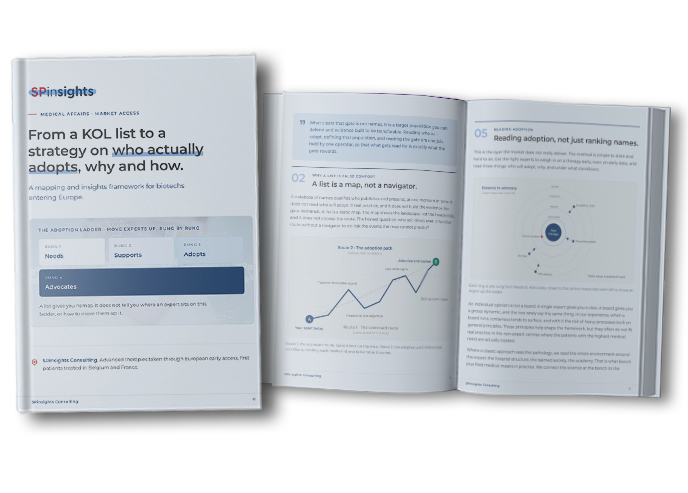
A list gives you names. It does not tell you where an expert sits on the adoption ladder, or how to move them up it.
A marketing authorisation asks whether it works and whether it is safe. The reimbursement gate asks whether it is better than what already exists, for whom, and worth paying for, in real patients rather than trial patients. Assets stall at the second gate, and the evidence that clears it has to be designed in long before submission.
Internal validity, in trial patients. The regulator's question.
Real-world effectiveness, in real patients. This is where approved, physician-wanted therapies have still died in Europe.
Purchased databases surface academic visibility and under-weight the clinicians and committee members who actually decide local access. Only 8 to 18 percent of opinion leaders come back when re-identified two years later.
Get the right experts to weigh in early, even on early data, and read three things: who will adopt, why, and under what conditions. A board surfaces the group dynamic a single opinion never will.
Patients in the lead investigator's own region were 36 percent more likely to receive a new cancer drug in its first years. The window is real, and it fades within roughly four years.
The gap between efficacy in a trial and effectiveness in real life is the whole game. Across five European HTA agencies, indirect treatment comparisons were accepted 30 percent of the time, and zero percent in France.
From 12 January 2025, the Joint Clinical Assessment runs in parallel to EMA for new oncology medicines and all advanced therapy medicinal products, with a hard window to submit the assessment dossier.
The full nine-section read on who adopts and how an asset clears the European reimbursement gate. Built for early-stage biotechs in oncology and rare disease, advanced therapies included.